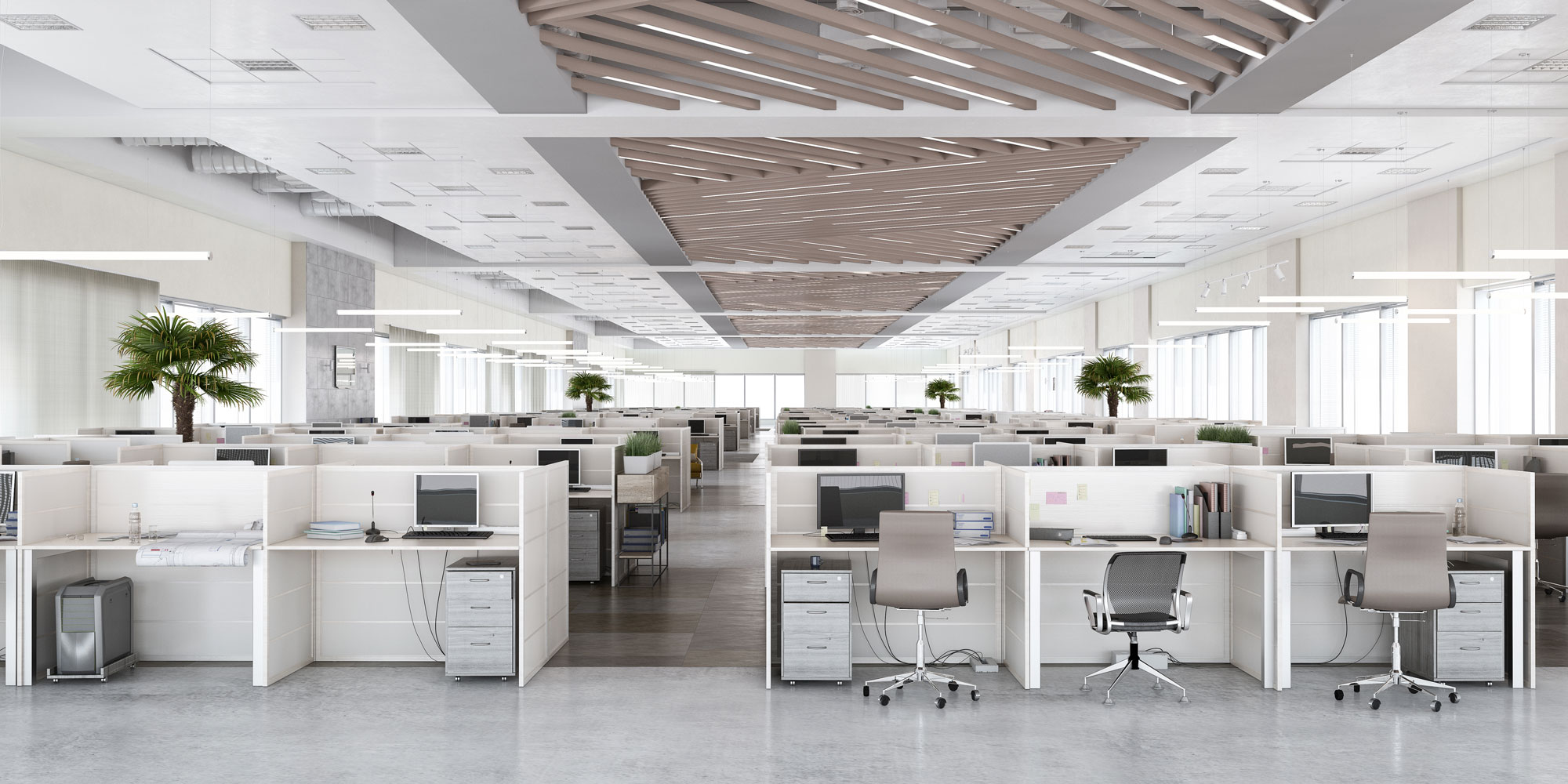

Most office buildings were designed around one simple assumption — everyone showing up five days a week to the same desk. Global office utilization sat at just 54% in 2025, with the majority of hybrid arrangements requiring three to four days in office.
A hybrid office relocation is a chance to rethink how much space your team actually needs to perform at their best and how that space should function. Technology has to be in place before anyone walks in, and the whole move has to run without disrupting the business along the way. Getting those pieces right and in the right order separates a smooth transition from a costly one. That’s where a truly coordinated relocation partner makes the difference.
How Hybrid Work Changes Your Office Relocation Strategy
Right-sizing an office space means matching space to how people actually use it. Hybrid work has changed the purpose of your office space, along with its square footage. Fewer employees may be there on any given day, but the space needs to work harder for the people who show up.
It now serves as a hub for collaboration, connection and focused work that employees can’t replicate at home. That shift changes how a hybrid office relocation should be planned from the very first conversation. That holds true whether you’re managing a single office site or a broader workplace relocation spanning multiple locations. Consider what’s already changing across the workforce:
- Peak attendance now drives space planning: Office utilization sits at capacity on peak attendance days for 73% of organizations, but only 34% report the same on an average day. That gap defines the right-sizing problem.
- Desk sharing is replacing 1:1 assignments: As hybrid schedules spread attendance across the week, dedicating a desk to a single employee wastes space that could otherwise serve multiple people on different days.
- Space allocation now favors collaboration: Rows of identical desks give way to zones built around the reasons people actually come into the office together, like project work, client meetings and team check-ins.
- Utilization data has replaced headcount as the baseline: As of 2025, 51% of remote-capable U.S. employees work a hybrid schedule and spend an average of 2.3 days per week in the office, a pattern that varies significantly by team and role.
What a Hybrid-Ready Office Actually Looks Like
Shifts in workplace expectations don’t stop at strategy — they also shape what a hybrid-ready office needs to look and feel like once you move in. Walk into a well-designed hybrid office and you’ll find:
- Activity-based zones: Dedicated spaces for collaboration, focused individual work, video calls and informal connection replace traditional cubicle setups. The desk-to-employee ratio reflects peak concurrent occupancy rather than the total headcount, since a flexible workspace only has to accommodate the busiest day. A department of 50 people who never all attend on the same day might need seating for 30, not 50. A typical hybrid office is now made up of 40%–50% focus space, 17%–25% amenity space and 15%–20% collaboration space. That mix reflects how differently people use the office today.
- Touchdown spaces: These give employees who come in occasionally a place to land without needing an assigned seat. It’s part of why only 25% of companies now use assigned seating, down from 40% in 2024 and 56% in 2023. Meeting rooms follow the same logic, since most meetings involve fewer people than the rooms built to hold them.
- Right-sized spaces: Right-sizing office space means matching room capacity to how meetings actually happen most of the time. The average space per person dropped from 171 to 165 rentable square feet year over year, with many organizations now targeting closer to 132 square feet. A handful of large conference rooms designed for a dozen people often makes less sense than a broader mix of small huddle rooms. A few larger spaces can stay reserved for bigger gatherings.
- Acoustics and connectivity: These matter more in this kind of open layout. Focused work and casual conversation now happen closer together than they did in a traditional office. Sound-dampening materials, enclosed phone booths and well-placed sightlines help keep noise from bleeding between zones with very different purposes. Mapping out these details before a single piece of furniture moves helps boost productivity and comfort.
Planning Your Hybrid Office Relocation
Post-COVID office relocations involve more interdependent decisions to sequence than the moves most companies managed before, when attendance patterns were far more predictable. Space design, technology provisioning, decommissioning and lease terms all depend on each other. Signing a lease before finalizing your floor plan, for example, can lock you into a footprint that doesn’t match your actual desk ratio needs. Getting the order wrong in one area often delays everything else downstream, sometimes by several weeks.
1. Create a Timeline
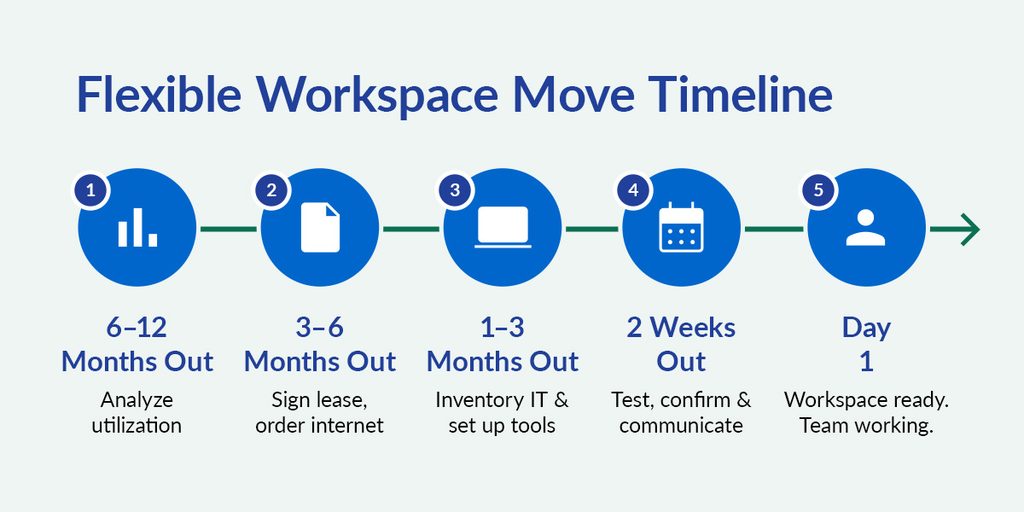
Planning a move to a flexible workspace should start with utilization data, not headcount. Knowing how employees actually use your current space is the only reliable basis for right-sizing the new one. That data should drive every phase of your hybrid work office move, starting well before you sign a new lease:
- Six to 12 months out: Pull attendance and utilization data from your current space, review existing lease terms and decommissioning obligations, and set a scope and budget.
- Three to six months out: Sign the new lease, order internet service immediately, lock in floor plan and desk ratio decisions and select a project management partner.
- One to three months out: Complete a full IT inventory and labeling process, configure desk booking and room scheduling software and finalize the decommissioning scope.
- Final two weeks: Run a full technology dry run, confirm all vendor schedules and building access and communicate move details to every employee.
- Day one: The technology is live, the space is accessible, the equipment sits at its designated location and the team is operational from the start.
Internet service deserves special attention on this timeline. Fiber installation typically takes two to three weeks once ordered, and delays are common enough to push back your move date. That’s why ordering it the same day you sign your lease is worth the effort, even before the rest of the paperwork is finalized. A reliable move project management partner can help keep every phase on schedule, from the first data pull to the final walk-through.
2. Delegate and Outsource to Minimize Operational Disruptions
Executing a hybrid office relocation involves more moving parts than a traditional move. You’re transporting assets, decommissioning surplus equipment, coordinating multiple vendors and keeping a distributed workforce operational throughout the transition. All of this often happens across more than one physical location at once.
The difference between a smooth move and a chaotic one comes down to ownership. One party should be accountable for every workstream. Full-service moving services that combine these functions under a single team remove much of that risk before it ever arises.
Scheduling the physical relocation during off-hours or over a weekend protects business continuity and keeps employee disruption to a minimum.
3. Have a Clear Plan for Communication
Communicating the plan clearly and in advance matters just as much. That’s especially true for hybrid and remote employees who can otherwise feel left out of the loop on decisions affecting their daily routine.
Working with one point of contact removes the fragmentation and finger-pointing that comes from juggling separate movers, IT contractors, furniture installers and decommissioning teams. Employee experience in the workplace directly affects productivity and engagement, and a disorganized transition sends a clear signal about how a company values its people. Move coordination that keeps every workstream on one timeline turns a stressful weekend into a Monday nobody has to think twice about.
Prioritizing Technology and Infrastructure for the Hybrid Workplace
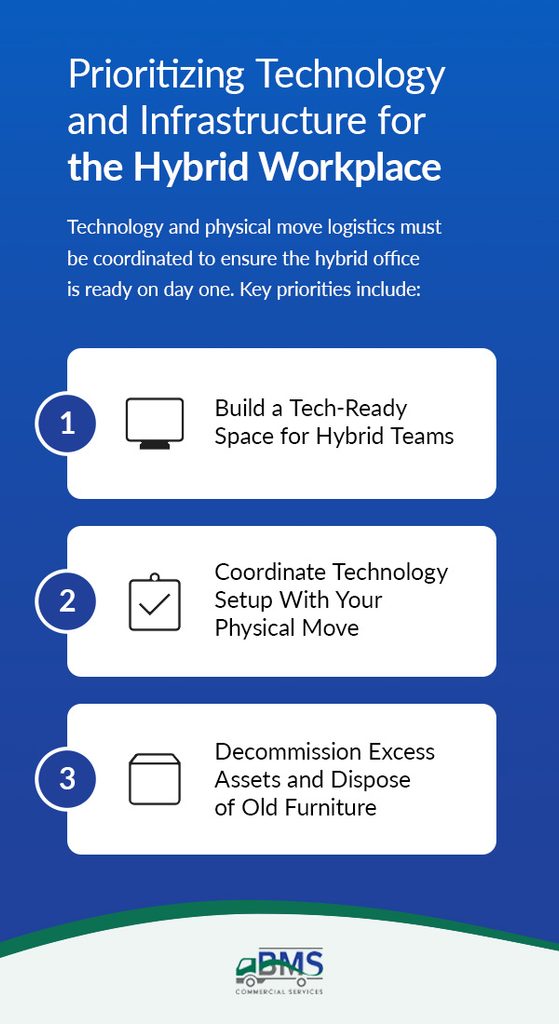
Technology is the connective tissue of a hybrid office, essential from day one rather than configured after the fact. A traditional relocation might allow IT setup to follow furniture installation on its own schedule, but a hybrid office can’t work that way. Physical move logistics and technology need to happen simultaneously, starting with the first vendor call and running through move day itself.
Employees rely on digital communication tools to stay connected during on-site and remote workdays. A team that arrives to no working connectivity, no desk booking system and no AV on day one is a team that can’t do its job.
1. Build a Tech-Ready Space for Hybrid Teams
A tech-ready hybrid office needs to function from the moment employees walk in. That starts with AV and video conferencing capability in every meeting room used for hybrid calls, working reliably the first time someone tests it. Wi-Fi coverage should extend across the entire floor plate, including enclosed offices, conference rooms, open areas and collaborative zones alike.
Desk booking and room scheduling software should be configured and live before anyone arrives. With 68% of organizations now requiring defined in-office days, these systems are standard infrastructure rather than a nice-to-have. Power and connectivity need to reach every potential work point, from open desks to shared tables to informal seating areas throughout the space.
Smart building integrations like occupancy sensors and visitor management can add another layer of function where they fit. These tools give facility teams better visibility into how the space actually gets used over time. A technology integration partner can confirm all of these pieces are working before move day.
2. Coordinate Technology Setup With Your Physical Move
Tech provisioning is a commonly underestimated aspect of a hybrid office relocation, largely due to timing. Internet service should be ordered the same day you sign your lease to help avoid delays. IT equipment inventory and labeling need to happen before anything is physically moved. That way, nothing gets lost or misrouted between locations during the transition to the new space.
Technology installation and furniture installation should run in parallel rather than one after the other. A full dry run of every system belongs on the schedule ahead of move day, giving any gaps time to surface while they’re still fixable. Skipping these steps is how moves slip past their scheduled weekend window and become Monday-morning downtime for the whole team. Relocation project management that treats technology and physical logistics as one coordinated plan is what keeps that from happening.
Being Monday-ready means connectivity is live, equipment sits at the right location and desk booking software is active and ready to use. The space itself needs to be fully accessible and functional the moment the first person walks in, so teams are prepared to stay engaged with minimal disruptions.
3. Decommission Excess Assets and Dispose of Old Furniture
Every move leaves behind equipment and furniture that requires responsible, well-documented handling. Downsizing office space typically means parting with cubicle systems, outdated workstations, surplus furniture and decommissioned electronics. What happens to those assets afterward matters as much as removing them, since responsible handling takes more than a dumpster. The challenge scales with the trend of real estate footprint reduction already underway.
It involves eco-friendly disposal through certified recyclers and donation programs for furniture that still has useful life left. Proper data security matters especially for retired hardware and drives that may still hold sensitive company information. Certificates, donation records and asset manifests help confirm where everything went, who received it and when the transfer took place.
Managing decommissioning and removal as part of the broader relocation, rather than as a separate vendor relationship, keeps this workstream entirely off your plate. Some assets need to move somewhere else rather than leave the building outright. In those cases, secure interim storage offers a place to hold them until the new space is fully ready.
Plan a Seamless Hybrid Office Relocation With BMS Commercial Services
A hybrid office relocation touches every part of your business, from space planning and technology setup to decommissioning and move-day execution. Managing each piece separately through several different vendors is where most of the friction typically occurs. BMS Commercial Services brings all of it under one team, one timeline and one point of contact. Our approach is backed by over 80 years of experience and a nationwide network built to support businesses wherever they operate, in whatever markets they serve.
Whether you’re right-sizing your footprint or coordinating a move across multiple locations, our team handles the complexity so yours can stay focused on the work. Contact us online or call us at 833-901-2811 to start planning your hybrid office relocation with peace of mind.