

Office relocations bring opportunity, from new space, better layouts and even fresh energy. However, they can also bring resistance. Research from Development Dimensions International (DDI) shows that only 13% of HR leaders believe their organization’s leaders can effectively manage change. When staff feel uncertain about the move, morale dips, productivity suffers and timelines slip.
The difference between a disruptive move and a strategic transition comes down to change management. Companies that address employee concerns systematically see higher productivity during the move, faster adjustment afterward and stronger team cohesion. How you handle the human side of your office relocation directly affects your operational continuity.
Foundational Elements for a Successful Move
To build a strong foundation for any office relocation, it’s crucial to understand the essential role of employee buy-in and the critical guidance leadership provides.
The Critical Role of Employee Buy-In
Office relocations introduce uncertainty that triggers resistance. Employees worry about changes to commutes, unfamiliar surroundings and disrupted workflows. When leadership fails to address these concerns proactively, resistance manifests as decreased engagement, lower morale and reduced productivity during the transition period. In fact, only 31% of change projects achieve their objectives. The remaining 69% often face implementation delays, budget overruns or abandoned initiatives.
Employee buy-in is one of the clearest levers leadership has to support a successful transition. Weak buy-in can translate to extended downtime, lost revenue and damaged team dynamics. Buy-in develops when employees understand the business rationale. They need to understand the personal benefits and trust that leadership has planned for their needs. Companies that secure early buy-in often report smoother transitions, with teams maintaining productivity levels throughout the move and adapting quickly to new spaces.
The Role of Leadership in Managing Change
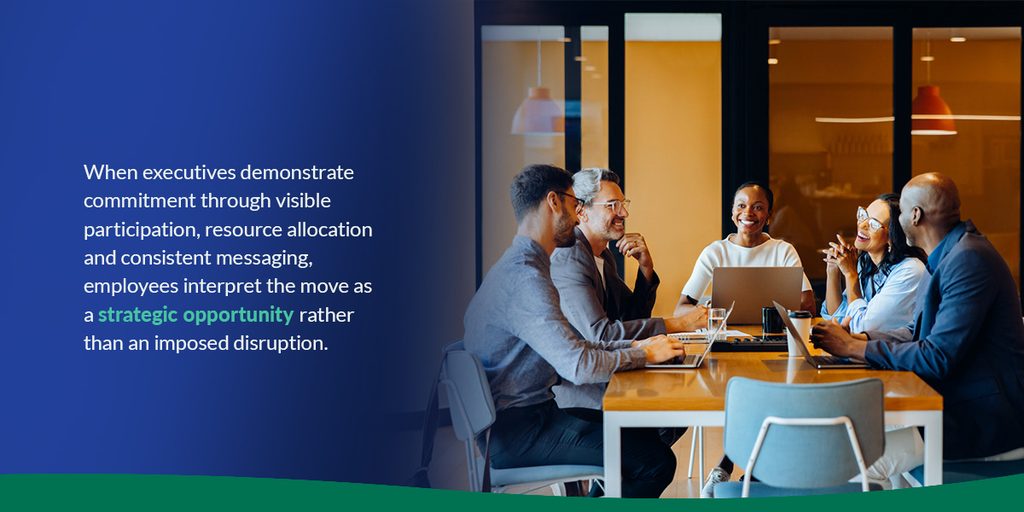
Leadership sets the tone for how employees experience relocation. When executives demonstrate commitment through visible participation, resource allocation and consistent messaging, employees interpret the move as a strategic opportunity rather than an imposed disruption.
Visible commitment means more than announcements. Tour the new space with your teams, participate in planning sessions and address concerns face-to-face. This hands-on approach signals that the relocation matters at the highest level, and that employee input shapes the outcome rather than just what leadership decides behind closed doors. Effective change management during an office move requires leaders who model adaptability and maintain open dialogue throughout the process.
Allocating resources to change management activities, employee support services and workspace customization demonstrates that leadership values the employee experience. Consistency matters throughout the timeline, too. Leaders who maintain regular communication, follow through on commitments and adjust plans based on employee feedback build trust that carries beyond the relocation.
Implementing Your Relocation Change Management Plan
Successfully implementing your relocation plan requires deploying a range of strategic initiatives, from clear communication and managing resistance to ensuring operational continuity and providing robust employee support.
1. Build Confidence Through Transparent Communication
Communicating the move to employees early and clearly sets the tone for the entire transition. Effective relocation communication addresses employee needs around timing, rationale, personal impact, support resources and feedback channels. Transparency helps prevent rumors from filling the information gap. Employees process change differently, so relying on one channel or a single big announcement inevitably leaves some people out of the loop.
Here’s what that communication needs to cover:

- Share the timeline early: Provide relocation milestones, move dates and decision deadlines, even if details are still forming. Employees appreciate predictability over perfection. Update the timeline as circumstances change and explain why adjustments are necessary.
- Clarify the rationale: Explain why the move benefits the company and how it creates opportunities for employees. Employees support changes they understand, so tie business objectives to improvements in the employee experience, such as better facilities, enhanced technology or improved collaboration spaces.
- Get specific about personal impact: Detail how the relocation affects daily routines, commute options, parking availability, workspace configurations and amenity access. The more concrete the information, the less room for speculation.
- Offer real support, not just promises: Make it easy for employees to get help. Provide access to moving coordinators, IT support during the transition and resources for adjusting to the new location.
- Create accessible feedback channels: Multiple ways for employees to ask questions, share concerns and offer suggestions work better than a single comment box. Use surveys, town halls, team meetings and direct conversations with managers and respond to feedback publicly when possible to show that leadership is listening.
2. Transform Resistance Into Engagement
Resistance to office relocation stems from legitimate concerns about disruption, inconvenience and uncertainty. Treating resistance as a problem to overcome misses an opportunity to address valid issues and improve the relocation plan. Common sources of resistance include:
- Commute changes that affect work-life balance
- Concerns about new workspace functionality
- Anxiety about team separation
- Fear of productivity loss during the transition
Understanding employee resistance during office relocation helps leadership develop targeted solutions that address root causes rather than surface complaints. Each concern deserves acknowledgment and a specific response.
- Acknowledge concerns without dismissing them: When employees express resistance, listen to the underlying issue. A complaint about commute time might reflect childcare constraints or concerns about work-life balance. Understanding the root cause enables meaningful solutions.
- Provide specific solutions to identified concerns: If commute length is an issue, explore flexible start times, remote work options or transportation subsidies. If workspace concerns arise, offer tours, trial periods or customization options. Concrete solutions demonstrate that you take the issue seriously.
- Involve resistant employees in solution development: People support what they help create. Form working groups that include skeptical voices to address specific relocation challenges, since involvement often transforms resistance into ownership as employees contribute to solutions.
- Share how feedback shapes the plan: When employee input leads to changes, communicate this clearly. Don’t just collect feedback — show what changed because of it.
3. Minimize Workflow Disruptions
The question isn’t whether disruption will occur, but how well you plan for it. Managing staff during relocation requires clear protocols that preserve essential functions while accommodating the complexities of transitioning to a new workspace.
The transition typically spans three phases, including pre-move preparation, move execution and post-move stabilization, each of which presents distinct workflow challenges:
- Pre-move preparation: This stage involves documenting current processes, identifying critical functions and developing contingency plans. Map which tasks require specific equipment, which processes depend on physical proximity and which functions can operate remotely, and lean on solid office asset tracking and inventory to keep equipment accounted for throughout the move. This analysis identifies vulnerabilities and informs backup procedures.
- Move execution: Executing the move itself requires clear protocols for maintaining essential operations. Stagger departmental moves to preserve critical functions, establish temporary workspaces for essential personnel and create communication channels that function regardless of physical location. Companies that plan for partial operations during the move maintain service levels and prevent revenue loss.
- Post-move stabilization: The final phase focuses on re-establishing normal operations in the new space. Prioritize unpacking and setup for revenue-generating teams, ensure the IT infrastructure is fully functional before expecting normal productivity and allow time for employees to adjust to new layouts and workflows. Rushing this phase creates frustration and extends the true adjustment period, so give the process the time it needs.
4. Train for New Workspace Environments
New office spaces often include updated technology, different layouts and enhanced amenities, all of which require employee orientation. Comprehensive training ensures teams can use new features effectively rather than struggling with unfamiliar systems. Consider the following:
- Technology training: This should begin before move day. Provide hands-on sessions with new equipment, software platforms and building systems. Record training sessions for reference, and create quick-start guides for common tasks. IT support should be readily available during the first weeks in the new space.
- Workspace orientation: This helps employees navigate the new environment efficiently. Conduct tours that highlight key locations, explain booking systems for shared spaces and demonstrate any new workspace features. Familiarization reduces the time employees spend searching for resources or figuring out how things work.
- Amenity education: Encourage employees to maximize the value of new office features. If the new space includes fitness facilities, collaboration zones or enhanced break areas, show the team how to access and use these resources. Otherwise, the investment in those amenities goes unused.
5. Create Comprehensive Support Systems
Structured support systems help employees manage the practical and emotional aspects of office relocation. These systems address immediate needs and build long-term confidence in the new workspace:
- Designate transition coordinators: As the go-to resource during the move, these individuals answer questions, troubleshoot issues and escalate concerns that require leadership attention. Establish peer support networks that connect employees facing similar challenges, such as new-space adjustment groups, commute-sharing arrangements and neighborhood exploration teams. These create a community around the transition, which can reduce isolation and help employees adapt together.
- Provide mental health and stress management resources: Relocations create genuine stress, particularly for employees facing significant changes in commute or workplace uncertainty. Access to counseling services, stress management workshops or flexible scheduling during the adjustment period demonstrates that employee well-being matters.
- Monitor support system usage: Ongoing monitoring helps you identify gaps throughout the process. If a few employees use designated resources, investigate why. The issue might be awareness, accessibility or misalignment with actual needs.
Optimizing and Sustaining Change Efforts
Optimizing and sustaining your change efforts requires continuous evaluation of progress, strategic timeline management and a proactive approach to avoiding common pitfalls.
Measuring Change Management Effectiveness
Tracking employee adaptation provides insights into what’s working and where you need additional support. Measurement should be ongoing throughout the relocation timeline, not limited to post-move surveys.
Pre-move metrics establish baselines for comparison. Measure current employee satisfaction, productivity indicators, engagement scores and absenteeism rates. These benchmarks reveal whether the relocation improves, maintains or diminishes organizational health.
Tracking progress and patterns during the move identifies real-time issues. Monitor help desk requests, support resource utilization and informal feedback channels. Spikes in certain issue types signal where you need additional resources or communication, and a quick response to emerging patterns prevents small problems from becoming major obstacles.
Post-move evaluation assesses overall effectiveness and long-term impact. Survey employees at 30, 60 and 90 days to track adaptation progression. Compare productivity metrics, retention rates and engagement scores to pre-move baselines.
Timeline Considerations for Change Management
Change management activities should align with your broader commercial move planning timeline, beginning months before the move and extending through the adjustment period. Proper sequencing helps employees receive information and support when they need it most.
- Six months before the move: Announce the relocation, share initial rationale and establish feedback channels. Form employee working groups to address specific concerns, and begin baseline measurement of employee satisfaction and productivity.
- Three to four months before the move: Provide detailed information about the new location, including commute options, workspace layouts and amenity details. Conduct site tours if possible. Offer training on new technology or systems, and address emerging concerns through targeted communication.
- One to two months before the move: Finalize individual workspace assignments, share packing and preparation guidelines and confirm move day logistics. Intensify communication frequency to maintain awareness and reduce anxiety. Ensure everyone knows their roles during the move.
- Move week: Provide daily updates on move progress, maintain accessible communication channels for real-time questions and ensure support resources are readily available. Acknowledge that productivity will drop and adjust expectations accordingly.
- First month after the move: Maintain heightened support and communication. Address workspace issues quickly by gathering feedback on what’s working and what needs adjustment. This helps employees establish new routines.
- Two to three months after the move: Assess progress in adaptation, make necessary adjustments to workspace or processes. Celebrate successful transition milestones and recognize teams that adapted well.
Common Change Management Mistakes to Avoid
Office relocation change management fails when companies make predictable errors that undermine employee confidence and create unnecessary resistance. Examples include:
- Announcing too late: Employees who learn about relocations through rumors or at the last minute feel excluded from important decisions. Early announcement, even when details are incomplete, respects employees and enables gradual adjustment. Late announcements trigger distrust that persists throughout the move.
- Underestimating emotional impact: Treating relocation as purely logistical ignores the genuine stress and adjustment challenges employees face. Workspaces carry personal meaning, and routines provide comfort. Change creates anxiety even when ultimately positive.
- One-directional communication: Announcing decisions without creating feedback mechanisms signals that employee input doesn’t matter. Change management requires dialogue, not just information delivery.
- Ignoring resistant voices: Treating resistance as defiance rather than valuable feedback misses opportunities to address legitimate concerns and improve the relocation plan. Resistant employees often identify real problems that require solutions.
- Declaring victory too early: The physical move being complete doesn’t mean employees have actually adapted. New routines, workflows and relationships need time to feel natural, and premature withdrawal of support leaves people struggling.
Partner With Office Relocation Specialists
Executing a full-service commercial office relocation while maintaining operational continuity and employee confidence requires specialized expertise. BMS Commercial Services brings decades of experience helping organizations navigate complex relocations with minimal disruption.
Our teams understand that successful moves depend on more than logistics. We coordinate with your change management initiatives, work within your communication timelines and support your employee experience goals throughout the transition. From initial planning through post-move adjustment, we handle the operational details so you can focus on your teams.
Ready to discuss your upcoming office relocation? Request a consultation to learn how we can support your organization through a successful workplace transition.