

You’ve been tasked with planning an office relocation. That means you need a well-structured request for proposal (RFP) to make the move successful. A detailed RFP enables you to compare vendors fairly, set clear expectations from the start and ensure every provider is pricing the same scope of work. It transforms an ambiguous procurement process into a structured, apples-to-apples evaluation.
When your RFP clearly defines the project, vendors respond with specifics and realistic bids. You get itemized cost breakdowns, verifiable credentials and responses you can actually compare. This guide shows you exactly what to include in your office moving RFP and how to use it to identify the most qualified partner, giving you the clarity and confidence to move forward.
How to Write an Office Moving RFP
The goal of your RFP is to give every vendor the same detailed picture of the project, so responses are based on the same scope and accurate information. Providing greater specificity on the following factors leads to more competitive bids:
Project Scope and Timeline
Start with the details that every vendor needs to price your project precisely. Defining the schedule with specific days and times is foundational — generic timing creates bid disparity that leads to disputes later. This level of detail ensures full-service office relocation providers can deliver realistic cost estimates.
Your RFP should address these core elements:
- Origin and destination addresses: Include floor numbers, building names and any relevant site identifiers.
- Total square footage: Specify the area being relocated.
- Estimated inventory size: Provide approximate volume or number of workstations.
- Move dates and windows: Define whether the relocation happens over a weekend, during after-hours or in phases across multiple days.
- Operational blackout dates: List any dates when moving cannot occur.
- Phase definitions: Outline each phase for multi-department or multi-floor relocations and identify cutover points so vendors can plan sequencing.
Building Access and Logistics
Both your current and destination buildings have logistics that movers need to understand up front. Document freight elevator reservation windows, loading dock access hours and any floor or wall protection requirements mandated by building management. Note rules around moving hours, permits or security escort requirements.
Any qualified service provider should request a pre-move walk-through of both sites before submitting a bid. Companies that price your project without walking the space are making estimates based on assumptions rather than on site-specific conditions.
Building egress requirements — entry and exit points, elevator dimensions and building management restrictions — are foundational components of an RFP. Reviewing these prevents access issues on move day and ensures bidders account for site-specific challenges in their pricing and planning.
Services Required: Packing, IT and Furniture
Your RFP must clearly define who handles what. Ambiguity here creates the most common source of change orders. Explicitly addressing PC disconnection and moving, as well as cubicle assembly and packing responsibilities, in your scope of work ensures nothing is left undefined.
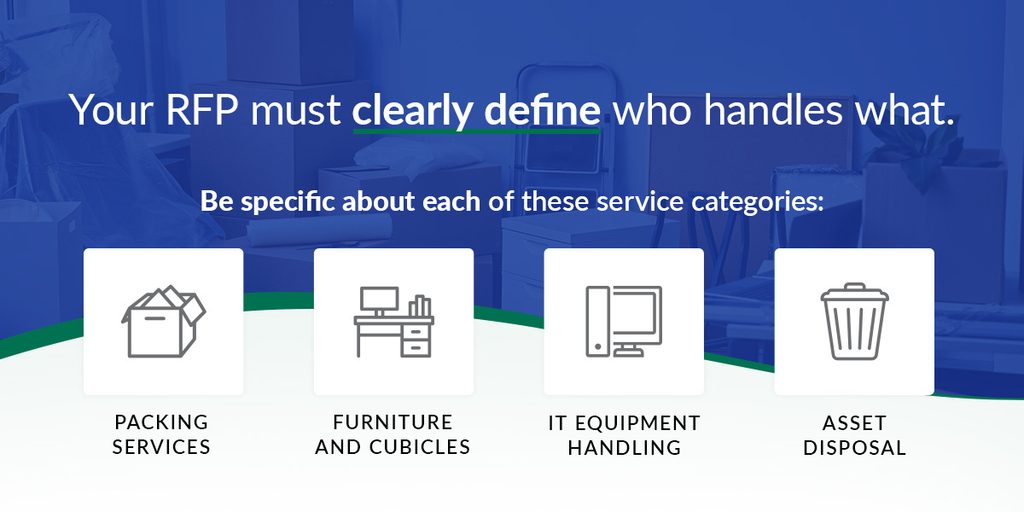
Be specific about each of these service categories:
- Packing services: State whether packing is provided by the mover or managed internally, and for which areas — executive offices, general workstations, file rooms, storage areas.
- Furniture and cubicles: Address cubicle disassembly, furniture installation and cubicle reconfiguration expectations.
- IT equipment handling: Define chain-of-custody protocols, disconnection and reconnection responsibilities, labeling systems for servers and workstations and data security measures during transit.
- Asset disposal: Reference your decommissioning and asset removal requirements if relevant.
Pricing, Valuation Coverage and Licensing
Ask vendors for itemized cost breakdowns, not a single flat-rate number. They help you evaluate the true cost of each proposal and avoid hidden costs that arise during office moves due to vague pricing structures. Your RFP should require that bids break out labor, equipment, materials, overtime or weekend rates and any potential change-order triggers.
When business continuity is at stake, select your commercial moving company based on scope clarity and capability, with price as one factor among several.
For coverage, use the term “valuation” when discussing protection for belongings in transit. Ask movers to detail the valuation options they offer and what each covers.
For interstate moves, verify credibility by requiring providers to include their USDOT number and Motor Carrier operating authority in their submission. You can verify interstate mover registration through the FMCSA’s mover search tool. For local or intrastate moves, confirm any applicable state or local licensing requirements in your area.
References and Submission Requirements
Require each bidder to provide two to three client contacts from comparable commercial relocations completed within the past one to two years — similar in size, industry or complexity. Examples from residential moves or small office projects don’t demonstrate the capability you need. This time frame and project scope matching helps you vet commercial relocation quality.
Define response parameters like format, deadline and a single point of contact for questions during the RFP period. Standardizing how companies respond transforms a stack of incomparable documents into an actual decision-making tool.
How to Evaluate and Compare Commercial Moving Bids
Once proposals come back, your RFP becomes your evaluation scorecard. If every vendor responds to the same criteria, you can now compare on substance and detail. Be strategic when choosing office movers and follow this informed decision-making process.
Evaluate Scope Completeness Beyond Price
Use your RFP structure as a checklist. Each provider should address every section you outlined. Gaps indicate guesswork, which later becomes change orders. Vague RFP language forces companies to fill in the blanks with estimates, creating discrepancies across bids and issues on moving day.
Review the cost structure to see if it’s firm-fixed or hourly-only. A dedicated project manager and on-site supervisor should be included with the crew. The scope should encompass packing, IT handling, furniture installation and building protection. The most detailed, specific response from a company that asked thoughtful questions during the walk-through is usually the most reliable when selecting a commercial moving company.
7 Red Flags to Watch For
Evaluating office movers means recognizing behavioral and contractual signals that predict problems. Pay attention to these issues during the vendor selection process:
- Pressure tactics: A red flag is a demand to sign immediately, without time to review the contract.
- Evasive communication: Expect slow responses or vague answers during the RFP phase, signaling how communication may unfold during your actual move.
- One-sided change order clauses: Watch out for contract language that grants unchecked pricing flexibility.
- Large up-front deposits: Significant payment requests beyond a standard booking fee should raise a concern.
- Unverifiable client contacts: References that don’t respond or provide only residential project examples when commercial experience is needed are problematic.
- Missing insurance documentation: Failure to provide proof of workers’ compensation insurance or a certificate of insurance is a warning sign.
- Overpromising on timelines: Be wary of aggressive schedules demanded without a clear basis or plan.
Move Your Office With BMS Commercial Services
With over 80 years of experience and a nationwide network, BMS Commercial Services offers a single point of contact who coordinates moves, installations, storage and decommissioning under one contract.
We’ll streamline the complexities of your office relocation so you can focus on business success. Our professionals manage every phase and vendor, keep your project on budget and on schedule and deliver a fully operational workspace when your staff arrives.
Ready to move forward? Get a free quote online now.